Skip to content
Prices read
25
Suppliers
8
Range per year
EUR 2,650 to EUR 20,000

Press questions in the Netherlands

How Dutch organisations answer a press question on deadline

A journalist is on the line and the deadline is theirs, not yours. This site shows what to say first, who should speak, and what a press desk costs.

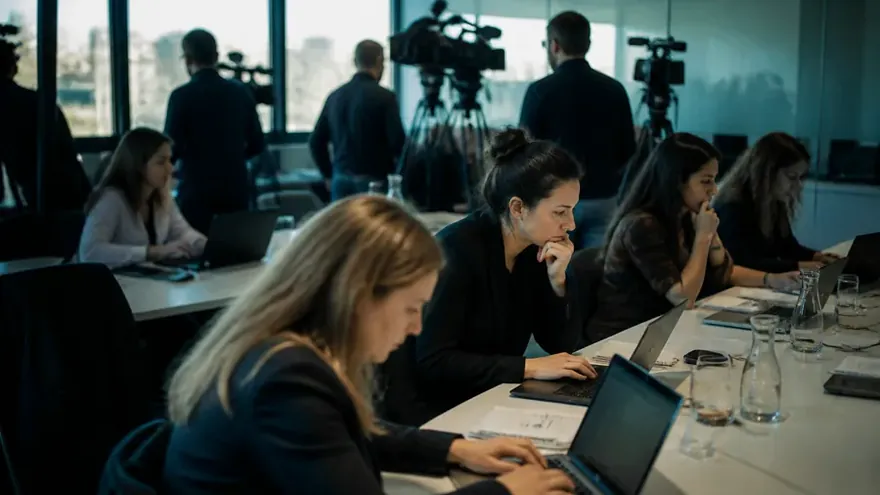
A newsroom on deadline: reporters at laptops with television cameras behind them
A press room on a working afternoon. Everyone in it is writing to an hour, and the hour is not yours.
The eight sections

Go straight to a section

Eight sections, each about one part of a press question: the first reply, the deadline, who speaks, what you may say, a bad day, your type of organisation, the desk itself, and the bill.

  1. 01Answering the call25 guides
  2. 02Deadlines25 guides
  3. 03Who speaks25 guides
  4. 04What you may say25 guides
  5. 05When it goes wrong25 guides
  6. 06Per organisation25 guides
  7. 07The press desk25 guides
  8. 08What it costs25 guides
Example: a reply to a journalist

A good press reply and a bad one, side by side

Both are honest. Only one of them gives the reporter something to print that you chose yourself.

Struck through“No comment at this time.”

It is not neutral. It reads as a decision to hold something back, and it leaves the newsroom with one line and no facts, on deadline.

Marked to keepWe can confirm the inspection took place on Tuesday. The findings sit with the board until Thursday, and I will call you the moment they are released.”

The same position, said out loud in two halves: one fact you can point at, one thing you do not have yet, and a time. That is the whole method.

How to read the marked-up examples on this site

A desk editor works with a marker and two pencils. So does this site, and each mark carries one meaning only, everywhere.

before 16:00 today

Yellow: a line you can say to a journalist

What you say. A line you can hand over exactly as it stands, because there is a time or a page behind it.

no comment for now

Red: a line to hold back for now

What you do not say yet. Often not even wrong, but not yours to say at this minute, and it will be quoted as if it were.

14 August

Blue: a date, amount or source you can check

Structure and reference: a date, an amount, a source, the way back to where a figure came from.


“Not yet” is an answer. “No comment” is a headline.

The line the eight moments below are built on

Why no comment backfires

Why no comment is the worst reply to a Dutch journalist

Most Dutch organisations do not get into trouble because they said something wrong. They get into trouble because they said nothing, slowly, and somebody else had to write the sentence for them. What is not in the inbox by the hour of the deadline is described in one line that you did not choose.

So the useful question is never whether to speak. It is which half of your answer is already solid. Almost every press question splits into a part you can confirm from a document today and a part that is genuinely not settled, and both halves go into the same email, with a time on the second one.

That is why everything here is marked in two colours. The marker is the part you can stand behind, because it is written down somewhere and dated. The red pencil is the part that may well be true but is not yours to release yet. Both belong in the reply. Only one of them belongs in quotation marks.

It also settles the order of your day. The organisations that come out of this well are not the fastest writers. They are the ones who already know who speaks, who approves, and where last year’s figures live. The eight moments below are that preparation, written out in the order a question actually arrives.

Silence is read as an answer too. It is just not the one you meant.
Someone working alone at a bench, concentrating on the piece in front of them
Preparation is the part nobody sees: who speaks, who approves, and where the figures live, settled before the phone rings.
Step by step

The eight steps of a press question, from the first call to the morning after

Find the moment you are standing in. Each one holds a single decision: the line under the marker is what you say, the line struck through in red is the one that is easiest to get wrong under time pressure. This is how a press question runs, not something we measured, so there is no source under these eight.

Hands working at a bench with the tools of the job laid out
Moment 01

Step 1: the journalist calls, write down the question and the deadline

Take the outlet, the reporter’s name, the question in their own words and the hour they file, in that order, before you say anything about the substance.

Not yetDo not answer the substance while you are still on the phone.

Nothing is off the record because you assumed it was.
Moment 02

Step 2: log the press question so the whole team can see it

Put it where every colleague can see it: who asked, about what, by when, and who owns it now. One list, one owner, one deadline per question.

Not yetDo not forward it to the person the question is about.

That is how a second, unprepared answer leaves the building.
Moment 03

Step 3: choose one spokesperson and one approver

Name one spokesperson and one approver for this question and say it out loud to both. A quarter of an hour in, the organisation has exactly one voice on this subject.

Not yetNo second voice, and no personal account replying in parallel.

An open ring binder with tabbed dividers, a magnifying glass and someone taking notes
Moment 04

Step 4: check what your organisation has already published

Annual figures, an earlier statement, a policy page: check what your organisation has already published on this. Answering from documents survives being quoted, answering from memory does not.

Not yetDo not confirm a number you cannot point at on a page.

“I will confirm that in writing within the hour” is a complete answer.
Moment 05

Step 5: send the reply in writing before the deadline

Answer before the deadline, in writing, in the language the reporter works in. Say what you can confirm, say plainly what you cannot say yet, and give the time at which you will know more.

Two halves in one email is not hedging. It is the only shape of an answer that survives being quoted, because the reporter can print both halves and neither one is a surprise to you the next morning.

Not yetDo not ask to read the whole article before it runs.

Checking your own quotes for factual accuracy is normal. Editorial control is not.
Moment 06

Step 6: expect a follow-up call to verify quotes

Expect one more call: a quote to verify, a second question, a request for a name and a photograph. Keep the same spokesperson on it and keep the log up to date.

Not yetDo not renegotiate what you already sent.

Moment 07

Step 7: read the published article and file it with the inquiry

Read what was published, note which of your lines were used, and file the piece against the inquiry in the same list.

Not yetDo not answer in the comments, and do not brief the board on the headline alone.

Printed pages laid out across a table in rows
Moment 08

Step 8: ask for a correction only when a fact is wrong

If a fact is wrong, ask the editor for a correction in writing, with the right fact and the page it is printed on. If it is a matter of framing rather than fact, note it and move on.

Not yetDo not demand a rectification for a story you simply dislike.

A correction you can prove costs you nothing. One you cannot costs you the next call.
What a press desk costs

What PR software costs in the Netherlands in 2026: from € 2,650 to € 20,000

A press desk is a person and a routine before it is a licence, but the licence is the part with a number on it. These are the yearly amounts suppliers print on their own pages, on one axis, read between 31 Aug 2026 and 1 Sep 2026. PR-Dashboard prints a figure for a press inquiry desk, which is why it is the first row.

  • PR-DashboardDe Perslijst€ 2,650a year · read on 31 Aug 2026 at pr-dashboard.nl
  • ANP ConnectDatabase only€ 2,990a year · read on 31 Aug 2026 at anpconnect.nl
  • PresspageBusiness essentialsfrom € 20,000a year · read on 31 Aug 2026 at presspage.com

Read as plain HTML, without JavaScript, on the dates shown. Amounts appear as the supplier prints them; where a supplier writes “from”, so do we. Suppliers who publish no readable yearly price are left out of this list, because a guess does not belong next to a measured figure.

What a spokesperson can look up on a supplier’s own page

One row per question a press desk asks before it buys anything, one column per supplier, read as plain HTML between 31 Aug 2026 and 1 Sep 2026. An empty cell means we did not find it on the pages we read.

CriterionPR-DashboardPrezlyPresspagepr.coPresscloudProwlyMynewsdeskCision
Size of the journalist databasestated in thousands; 10,000+ and about 12,000 both appearnot documentednot documentednot documented79,000+not documentednot documentednot documented
Digital accessibilitydescribed as a featurenot documentednot documentednot documentednot documentednot documentednot documenteda legal accessibility statement
Press-question moduleyesnot documentedyesnot documentednot documentednot documentednot documentednot documented
Dutch-language pages3100373744not documentednot documented0

Wide table. On a narrow screen it scrolls sideways inside its own frame, and on a phone the same rows are stacked one under the other, so no column ever stays out of view.

4 criteria across 8 vendors is 32 cells. We found 12 documented and 20 not documented on the pages we measured (31 Aug and 1 Sep 2026). An empty cell means we did not find it stated, not that the product lacks it: two of these vendors render their pages with JavaScript.

What a spokesperson can look up in public, on its own page with the sources

About this site

How this site is researched and written

The eight steps are editorial guidance, not a measurement

They describe how a press question runs in a Dutch organisation. They carry no source and no reading date, because there is nothing there to measure.

Every amount is read on the supplier’s own page, never estimated

Prices come from the supplier’s own page, fetched as plain HTML, with the day we read it printed next to the figure.

If a supplier publishes no price, we say so

Where a supplier documents nothing, we write that we did not find it on the pages we measured, not that it does not exist.

Thijs BakkerHow Dutch organisations answer a press question: who speaks, how fast, what the rules allow, and what a press desk costs.